
When Sales Assumptions Damage Customer Relationships |
|
Situational awareness and high-impact questions can make the difference between protecting a customer relationship and unintentionally damaging it. |
|
By Phil Whitebloom, Founder of BeenThere Consulting Service |
|
|
About a four-minute read |
|
|
Have you ever sensed that something was not quite right with a customer but never confirmed what was actually happening? A suspicion can quickly become an assumption. That assumption can influence your decisions and create the very customer relationship problem you were trying to avoid. I work with sales teams, business owners, and executives to improve the quality of their questions, uncover the real issues behind customer concerns, and handle objections more effectively. Schedule a conversation with Phil to discuss bringing a high-impact questions and objection-handling workshop to your business. |
|
|
Frank Thought He Was Doing the Right Thing Frank was a seasoned sales professional with a growing customer base and increasing demands on his time. Judy was relatively new to sales after being promoted from an administrative role. Her first sales assignment was to assist the senior salespeople while she learned the business. She was highly competent, dependable, and especially effective at gathering information and following through. When one of Frank’s significant customers requested a meeting to discuss an important high-tech solution, Frank delegated the meeting to Judy. On the surface, it appeared to be a reasonable decision. It was not. Based on a few previous interactions, Frank believed there was a personality disconnect between him and the customer. He was concerned that he had said or done something that irritated the customer. Frank decided Judy was better positioned to handle the situation. He believed he was protecting the customer relationship by sending someone capable, responsive, and removed from what he believed was the problem. The problem was that Frank never validated whether any tension between them actually existed. The customer could have been frustrated about something unrelated to Frank or the company. He could simply have been having a bad day when those earlier interactions occurred. Frank treated an assumption as a fact and made an important customer-retention decision based on it. |
|
|
Judy Did Everything Right Judy performed exactly as expected. She gathered the right information, identified the customers’ requirements, proposed the correct solution, and successfully resolved the technical problem. The solution worked. Before the meeting, there may or may not have been a genuine problem between Frank and the customer. Frank had never validated his assumption. However, there was now a real customer relationship problem. The customer fully expected and wanted Frank to take personal responsibility for the situation. When Frank sent Judy instead, the customer felt that he had been pushed aside. What Frank viewed as a thoughtful decision, the customer viewed as avoidance. Judy fixed the technical problem. Frank’s decision created a relationship problem. |
|
💡BeenThere Sales Tip of the Week |
|
When you suspect a problem, do not assume you know the cause. Address it professionally and validate what is really happening. You will either uncover an issue you can resolve or learn that there was no conflict at all. |
|
|
The Real Mistake Was Failing to Validate the Situation Frank did not know whether the customer was unhappy with him, whether the earlier interactions had any lasting meaning, or whether there was a problem at all. Had Frank addressed the situation directly and asked thoughtful, high-impact questions, he could have learned what the customer was actually thinking. Any genuine concern could have been discussed and repaired. It also could have become clear that the perceived tension had nothing to do with Frank. Either outcome would have been better than making an important account-management decision based on an untested assumption. Situational awareness in sales requires the courage and professionalism to face a potential problem head-on. However, it must be handled carefully so your attempt to identify a problem does not create one. Knowing how to ask high-impact questions helps you uncover what is really happening and determine the right course of action. |
|
|
Do Not Turn a Suspicion into a Fact Sales professionals naturally try to interpret a customer’s tone, reaction, or behavior. The danger begins when we decide we know the reason behind it without asking the questions necessary to validate it. A customer who appears short, distant, or irritated could be unhappy with you. The customer could also be dealing with an internal business problem, a personal concern, a difficult deadline, or something that has absolutely nothing to do with you. When you suspect a customer relationship problem, avoiding it allows assumptions to grow. Addressing it professionally gives you the best opportunity to understand the situation, improve sales communication, resolve legitimate concerns, and strengthen customer loyalty. The good news is that Frank and the customer eventually repaired their relationship. The customer remained Frank’s customer for more than 30 years. The relationship survived and became a powerful example of long-term customer retention. However, the damage and the time required to repair it could have been avoided by validating the situation before acting. |
|
|
What Are Your Salespeople Assuming? Business owners, CEOs, and sales executives should consider how often their teams make decisions based on what they believe a customer is thinking rather than what they have actually learned. High-impact questions uncover customer needs, expose hidden concerns, strengthen customer relationships, and improve objection handling. They also prevent sales professionals from responding to problems that may not exist. I am the author of Handling Objections: Clues for Closing the Sale and The Sales Fixer. My practical workshops help sales teams ask better questions, understand what is behind customer objections, and confidently move sales conversations toward the right outcome. The goal is not theory. It is to give your team techniques they can immediately apply to active opportunities, customer conversations, and account-management situations. To discuss a customized workshop on asking high-impact questions and handling objections, schedule a conversation with Phil. |
|
Good Selling! 🏢Founder, BeenThere Consulting Services
Contact Information: 📅 Schedule a conversation: https://forms.gle/346ZXKYfYqdbzqu19 📞 240-305-7149 📅 Schedule your Discovery Call here or scan the QR code below to schedule a conversation and explore what intentional coaching and disciplined preparation could look like for you and your team. |
 |
|
|
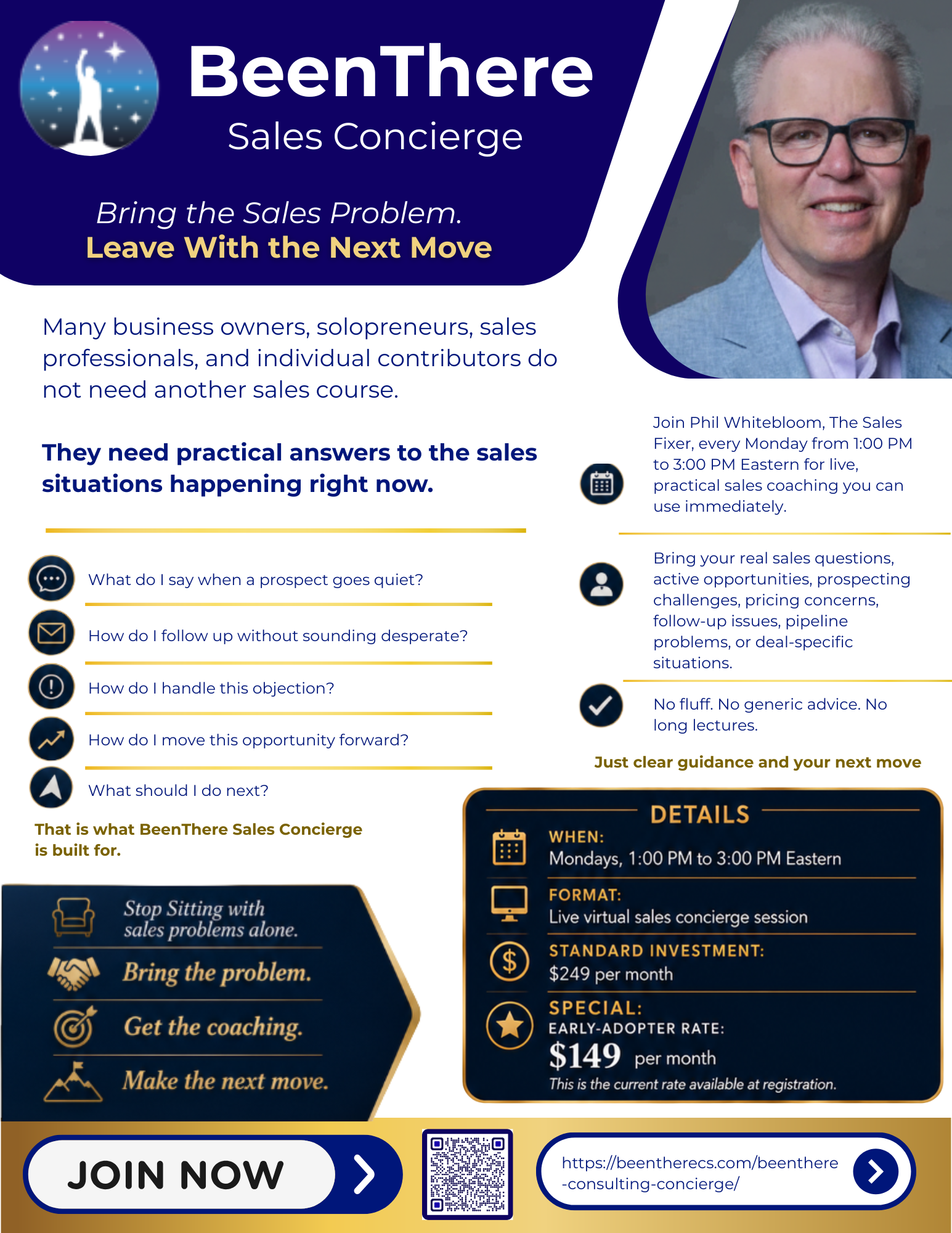
🤝Join us for at an Early Adopter Rate by clicking here, or scan the QR code below: |
 |
|
|
Have a topic you want me to cover next? Email me at phil@beentherecs.com. I read every note. |
|
 |
|
|


|